• About
    • Who We Are
    • Partners & Providers
    • News & Events
    • The ESRD Blog
    • Careers
    • Contact Us
  • Applications
    • What We Solve
    • Detailed Stress
    • Composites
    • Fracture Mechanics
    • Residual Stress
    • Sim Apps
  • Products
    • What We Develop
    • StressCheck Professional
      • StressCheck Core
      • Solvers
      • Advanced Modules
      • Utilities
      • Academic Licensing
    • StressCheck Apps
      • CAE Handbook
      • StressCheck Tool Box
    • Product Updates
  • Support
    • How We Can Help
    • Training
    • Webinars
    • Quick Start Guide
    • Help Documentation
    • Software FAQ’s
  • Simulation
    • How We Simulate
    • Benchmarks
    • Simulation Governance
    • History of FEA
    • Dictionary & Terms
  • Resources
    • Browse Our Resource Library
    • White Papers
    • Case Studies
    • Product Demos
    • StressCheck Tutorials
Serving the Numerical Simulation community since 1989
  • Contact Us
  • Register
Login
Forgot Password?
Join Us
ESRDESRD
ESRDESRD
  • About
    • Who We Are
    • Partners & Providers
    • News & Events
    • The ESRD Blog
    • Careers
    • Contact Us
  • Applications
    • What We Solve
    • Detailed Stress
    • Composites
    • Fracture Mechanics
    • Residual Stress
    • Sim Apps
  • Products
    • What We Develop
    • StressCheck Professional
      • StressCheck Core
      • Solvers
      • Advanced Modules
      • Utilities
      • Academic Licensing
    • StressCheck Apps
      • CAE Handbook
      • StressCheck Tool Box
    • Product Updates
  • Support
    • How We Can Help
    • Training
    • Webinars
    • Quick Start Guide
    • Help Documentation
    • Software FAQ’s
  • Simulation
    • How We Simulate
    • Benchmarks
    • Simulation Governance
    • History of FEA
    • Dictionary & Terms
  • Resources
    • Browse Our Resource Library
    • White Papers
    • Case Studies
    • Product Demos
    • StressCheck Tutorials

What Bottlenecks Limit the Adoption of Simulation Governance?

Home S.A.F.E.R. SimulationWhat Bottlenecks Limit the Adoption of Simulation Governance?

What Bottlenecks Limit the Adoption of Simulation Governance?

October 3, 2019 S.A.F.E.R. Simulation, The ESRD Blog
SAINT LOUIS, MISSOURI – October 2, 2019

ESRD Chairman and Co-Founder Dr. Barna Szabó

The idea of simulation governance is easy to understand:  The application of numerical simulation technology must be properly governed in every organization. The responsibility for simulation governance rests with board-level executives.  They exercise this responsibility through setting the goals, objectives and metrics to ensure that the economic value of numerical simulation is positive.  If numerical simulation is not managed properly then it can and often does lead to poor decisions that result in economic loss.  There are many well-documented examples of substantial economic loss that can be attributed to lack of simulation governance and management.

Recognizing the need to clarify the issues associated with the governance and management of numerical simulation, the Simulation Governance and Management Working Group of NAFEMS[1] has undertaken to develop a document on “What is Simulation Governance and Management”. An extract was published in the July 2019 issue of the NAFEMS quarterly Benchmark.
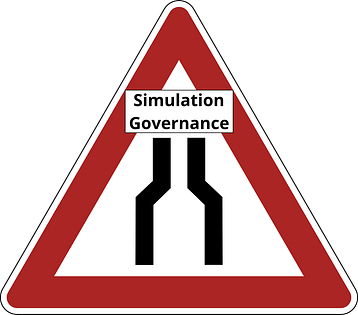
Beware the bottlenecks preventing the adoption of simulation governance.

While the concept is easily grasped, the existence of two bottlenecks must be recognized:  The first is that board-level executives generally lack the expertise to properly formulate realistic policies, expectations and metrics for numerical simulation and to assess the economic risks associated with numerical simulation activities within their organization.  Therefore it is necessary to engage outside consultants who have proper credentials and experience.   The problem is that it is extremely difficult to find consultants who are competent in this area.  This is because there are very few experts in numerical simulation and the consultant must also understand the intricacies of corporate change management.

The second bottleneck is that, with very rare exceptions, the technical staff do not have a clear understanding of what numerical simulation is.  There are historical reasons for this:  The primary tool of numerical simulation is the finite element method.  The legacy finite element codes, whose origins can be traced to the 1960’s and 70’s, were not designed to support numerical simulation.  In fact, numerical simulation, as the term is understood today, did not yet exist at that time.

An essential aspect of numerical simulation is that mathematical models must be formulated independently from how the numerical solution is obtained.  In contrast, legacy finite element software tools have the model definition and approximation conflated in their element libraries, making it very difficult, at times impossible, to separate model form errors from numerical approximation errors.  As a consequence, solution verification and model validation, which are essential elements of numerical simulation, cannot be reliably performed.

To eliminate this bottleneck it will be necessary to re-train the technical staff so that they will become proficient in the use of quality assurance procedures in numerical simulation.
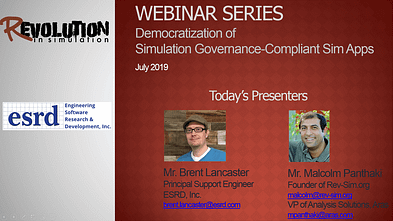
ESRD/Revolution in Simulation Webinar on Democratization of Simulation.

Management should also seek professional advice on the benefits and risks associated with Democratization of Simulation which must be subject to the rules of simulation governance.  The term means that numerical simulation tools are made available to engineers who do not have expertise in numerical simulation.  The goal is to increase productivity without sacrificing reliability through standardization of recurring numerical simulation tasks.  These tools must be carefully designed, tested and certified by experts for safe and efficient use.

The reasons why democratization tools should not be deployed without meeting the technical requirements of simulation governance are outlined in a 2018 presentation as well as in a joint webinar hosted by ESRD & Revolution in Simulation.

[1] NAFEMS is the International Association for the Engineering Modelling, Analysis and Simulation Community.  The parent organization was the National Agency for Finite Element Methods and Standards, established in the UK in 1983 with the objective to promote the safe and reliable use of finite element and related technology.

References

NASA Standard 7009: This NASA Technical Standard provides an approved set of requirements, recommendations, and criteria with which models and simulations (M&S) may be developed, accepted, and used in support of NASA activities.

Szabó B and Actis R. Simulation governance: Technical requirements for mechanical design. Computer Methods in Applied Mechanics and Engineering.  249-252, 158-168, 2012.

To receive future S.A.F.E.R. Simulation posts…

=
Loading
Tags: CAE HandbookFinite Element ModelingNumerical SimulationSimulation GovernanceStressCheck-Powered Apps
7

You also might be interested in

AA&S/PS&S 2019 Conference Recap
ESRD's booth at AA&S 2019 in Washington, D.C.

AA&S/PS&S 2019 Conference Recap

Apr 29, 2019

This past week at AA&S/PS&S 2019, ESRD's Gordon Lehman provided a training course titled “How Do You Verify the Accuracy of Engineering Simulations?”, chatted with attendees about StressCheck and how it supports detailed aerostructures analyses, and exhibited at our colorful & engaging booth. Read the summary of events and download the AA&S/PS&S training course presentation!

Happy Holidays from ESRD (2023 Edition)

Happy Holidays from ESRD (2023 Edition)

Dec 21, 2023

From all of us at ESRD, we wish you a very happy holiday season! We truly feel that each and every one of our users are part of the ESRD family and we are incredibly grateful to get to work with all of you. There is much we are thankful for as we approach the end of the year, and we'd like to take a moment to acknowledge some of the reasons we're looking back fondly on 2023...

Obstacles to Progress

Obstacles to Progress

Oct 24, 2023

The development of the finite element method (FEM) consists of two main branches: the art of finite element modeling and the science of finite element analysis. Learn why in this blog.

Leave a Reply

We appreciate your feedback!
Cancel Reply

You must be logged in to post a comment.

Looking for Resources?

Interested in a Demo, Evaluation or Purchase?

Have a Software Question, Issue or Feature Request?

Recent News & Events

  • Trustworthiness in Simulation: Credibility or Decision-grade Reliability?
  • Beyond the Black Box: Explainable AI Requires Explainable Simulation
  • Turtle Shells and Legacy Finite Element Codes: Evolutionary Constraints in the Age of Explainable AI

Quick Links

  • Quick Start Guide
  • Documentation
  • Software FAQs
  • Software Demos

Testimonials

  • “At DST Group, we have effectively used StressCheck over the last 10 years to determine accurate stress intensity factors. The results have been used to improve our residual strength and structural life estimates for aircraft in service with the Royal Australian Airforce, including C-130, P-3C and F/A-18 A/B. We have found it to be extremely easy to use and a very versatile code with which to create parametric models.

    We have recently used StressCheck to obtain improved stress intensity factor solutions (Improved stress intensity factors for selected configurations in cracked plates and Improved stress intensity factors for a single corner crack at a loaded fastener hole) for five key generic configurations. These transferable parametric results have been published externally. One specific example is the non-linear contact analysis of a cracked, filled fastener hole, with both fastener and remote plate loading.”

    Dr. Manfred Heller, Head
    Structural & Damage Mechanics, DST Group

Testimonials

When performing parametric structural analysis, ESRD’s p-element StressCheck FEA software is always my preferred choice due to the excellent solution quality, parametric framework, and superior computational efficiency. In fact, I recently used StressCheck to generate stress intensity factors along a parametrically defined elliptical crack-tip across 3,000 unique geometric configurations. Considering multi-body contact was present and all simulations were performed using a laptop, this was a task well suited for StressCheck.

Dr. Lee Zambino, Researcher, Villanova University

Member Portal

  • Member Registration
  • Member Login

Contact Us

© 2026 · Engineering Software Research & Development, Inc. | Terms & Conditions | Privacy & Cookie Policy | Software License Agreement | Software Maintenance and Technical Support Policy

Prev Next

We use cookies on our website to give you the most relevant experience by remembering your preferences and repeat visits, as outlined in our Cookie Policy. You may adjust your cookie preferences within .

ESRD
Powered by  GDPR Cookie Compliance
Privacy Overview

This website uses cookies to improve your experience while you navigate through the website. Out of these, the cookies that are categorized as necessary are stored on your browser as they are essential for the working of basic functionalities of the website. We also use third-party cookies that help us analyze and understand how you use this website. These cookies will be stored in your browser only with your consent. You also have the option to opt-out of these cookies. But opting out of some of these cookies may affect your browsing experience.

Strictly Necessary Cookies

Strictly Necessary Cookies should be enabled at all times so that we can save your preferences for cookie settings.