• About
    • Who We Are
    • Partners & Providers
    • News & Events
    • The ESRD Blog
    • Careers
    • Contact Us
  • Applications
    • What We Solve
    • Detailed Stress
    • Composites
    • Fracture Mechanics
    • Residual Stress
    • Sim Apps
  • Products
    • What We Develop
    • StressCheck Professional
      • StressCheck Core
      • Solvers
      • Advanced Modules
      • Utilities
      • Academic Licensing
    • StressCheck Apps
      • CAE Handbook
      • StressCheck Tool Box
    • Product Updates
  • Support
    • How We Can Help
    • Training
    • Webinars
    • Quick Start Guide
    • Help Documentation
    • Software FAQ’s
  • Simulation
    • How We Simulate
    • Benchmarks
    • Simulation Governance
    • History of FEA
    • Dictionary & Terms
  • Resources
    • Browse Our Resource Library
    • White Papers
    • Case Studies
    • Product Demos
    • StressCheck Tutorials
Serving the Numerical Simulation community since 1989
  • Contact Us
  • Register
Login
Forgot Password?
Join Us
ESRDESRD
ESRDESRD
  • About
    • Who We Are
    • Partners & Providers
    • News & Events
    • The ESRD Blog
    • Careers
    • Contact Us
  • Applications
    • What We Solve
    • Detailed Stress
    • Composites
    • Fracture Mechanics
    • Residual Stress
    • Sim Apps
  • Products
    • What We Develop
    • StressCheck Professional
      • StressCheck Core
      • Solvers
      • Advanced Modules
      • Utilities
      • Academic Licensing
    • StressCheck Apps
      • CAE Handbook
      • StressCheck Tool Box
    • Product Updates
  • Support
    • How We Can Help
    • Training
    • Webinars
    • Quick Start Guide
    • Help Documentation
    • Software FAQ’s
  • Simulation
    • How We Simulate
    • Benchmarks
    • Simulation Governance
    • History of FEA
    • Dictionary & Terms
  • Resources
    • Browse Our Resource Library
    • White Papers
    • Case Studies
    • Product Demos
    • StressCheck Tutorials

ESRD to Exhibit and Provide Training Course at ASIP 2018

Home EventsConferenceESRD to Exhibit and Provide Training Course at ASIP 2018

ESRD to Exhibit and Provide Training Course at ASIP 2018

September 4, 2018 Conference, Events

ASIP Header

ESRD, Inc. will be exhibiting and providing a training course at the ASIP Conference 2018 in Phoenix, AZ from November 26-29, 2018.  We hope you will drop by our training course and booth to check out the latest!

Training Course

The training course titled “Modeling Fastened Connections: Hierarchic Approaches Discussion and Demo” will be held Monday, November 26, 2018 / 6:00 PM – 8:00 PM by Mr. Brent Lancaster.  The description is as follows:

Reliable, high-fidelity analytical procedures for assessing fastened connections are critical for reducing unnecessary conservatism in design, reducing excess weight, increasing affordability and structural integrity, and decreasing the frequency of periodic inspections. These benefits can only be realized using properly formulated models solved by numerical methods, when the model definition and its numerical approximation are treated separately (a technical requirement of Simulation Governance). A hierarchic modeling strategy will be discussed to determine the simplest model from a family of models of increasing complexity that will provide reliable results for the intended use of the model, such that verifiable, relevant data from the region of interest can be extracted.

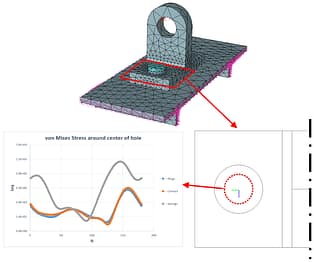
Comparison of von Mises stress distributions for fastened connection model hierarchies.

This short training course will discuss a hierarchic approach to modeling fastened joints using Finite element Analysis (FEA) with specific examples and case studies using professional FEA software. Model conceptualization, including all simplifying assumptions based on both the available information and the data of interest will be covered as well. Different models from the hierarchy will be demonstrated and compared to showcase how selecting the best model can save time and money, without compromising structural integrity or accuracy. The course will emphasize key post-processing capabilities that enhance the quality and reliability of contact analysis results.

Course Outline:

  • Modeling of fastened connections – a hierarchic approach using FEA Software – including  shear connections ignoring secondary bending, full multi-body contact (load transfer between all parts), partial contact (load transfer between notable parts only), and the use of compression-only distributed springs for single part analysis approaches.
  • Pros, cons and applicability of each hierarchic modeling approach will be analyzed.
  • Case Study: 3D bolted Lug Comparison – (1) Multi-body contact, (2) partial contact simplification & (3) compression-only distributed springs.
  • Live StressCheck Demo: Students will learn the process of checking reactions in contact regions/holes, as well as how to perform live-dynamic processing of detailed stresses in multi-part assemblies.
  • Q&A

The training course content structure will be based on our June 2018 webinar and recent S.A.F.E.R. Simulation blog article on Hierarchic Modeling:

  • Hierarchic Approaches to Modeling Fastened Connections Webinar
  • Why Is a Hierarchic Modeling Framework Important?


Register


Exhibit Booth

ESRD can be found at Booth 12 and will have several staff members available to chat and answer questions about StressCheck Professional, CAE Handbook, StressCheck Tool Box, DaDT applications, and more.
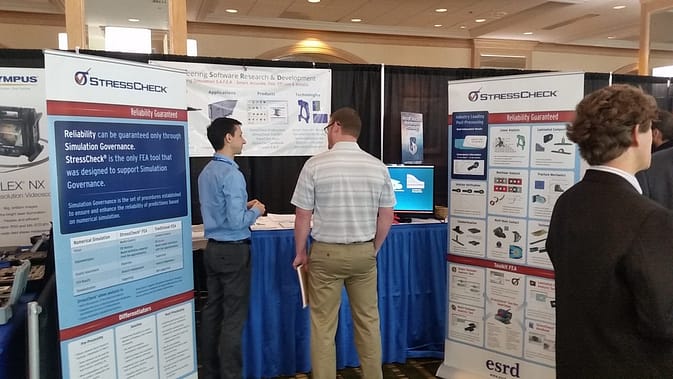
ESRD’s Matt Watkins talks to an ASIP 2017 attendee.

Contact information for ESRD staff is as follows:

  • Mr. Gordon Lehman, PE – gordon.lehman@esrd.com
  • Mr. Brent Lancaster – brent.lancaster@esrd.com


Tags: Aerospace and DefenseASIPDaDTFracture
1

You also might be interested in

ESRD Participates in the Engineered Residual Stress Implementation (ERSI) Workshop 2018

ESRD Participates in the Engineered Residual Stress Implementation (ERSI) Workshop 2018

Oct 8, 2018

ESRD's Dr. Ricardo Actis attended and presented with technology partner Analytical Processes/Engineered Solutions (AP/ES) at the Engineered Residual Stress Implementation (ERSI) Workshop 2018 in Clearfield, UT.  This annual workshop is focused on the development of a damage tolerance methodologies for fatigue crack growth through deep Engineered Residual Stress (ERS) fields.

S.A.F.E.R. Numerical Simulation for Structural Analysis in the Aerospace Industry Part 5: An Introduction to StressCheck for High-Fidelity Aero-structure Analysis
C130 Hercules transport aircraft.

S.A.F.E.R. Numerical Simulation for Structural Analysis in the Aerospace Industry Part 5: An Introduction to StressCheck for High-Fidelity Aero-structure Analysis

Apr 2, 2018

In this final post of our "S.A.F.E.R. Numerical Simulation for Structural Analysis in the Aerospace Industry" series, we will profile the stress analysis software product StressCheck®, what makes it different from other FEA software and the applications for which it is used in A&D engineering.[...]

Altair Innovation Intelligence Publishes a S.A.F.E.R. Simulation Primer

Oct 17, 2017

Last week, ESRD wrote a guest contribution for Altair’s Innovation[...]

Leave a Reply

We appreciate your feedback!
Cancel Reply

You must be logged in to post a comment.

Looking for Resources?

Interested in a Demo, Evaluation or Purchase?

Have a Software Question, Issue or Feature Request?

Recent News & Events

  • Trustworthiness in Simulation: Credibility or Decision-grade Reliability?
  • Beyond the Black Box: Explainable AI Requires Explainable Simulation
  • Turtle Shells and Legacy Finite Element Codes: Evolutionary Constraints in the Age of Explainable AI

Quick Links

  • Quick Start Guide
  • Documentation
  • Software FAQs
  • Software Demos

Testimonials

  • The capabilities available with BAMF, AFGROW and StressCheck are highly advanced and offer significant potential to achieve the high-level goal of TITANS –to reduce the need to conduct expensive and time consuming physical tests and to rely more on simulation.

    Dr. Kevin Walker
    Defence Science and Technology Group – Melbourne, Australia

Testimonials

The software provides a highly reliable and user-friendly production stress analysis tool that will replace the Finite Element Method (FEM) tools and failure criteria the experts currently employ for analyzing bonded joints. The software includes an FEM-based handbook format, which allows non-experts to utilize models prepared by specialists. The handbook problems include built-in failure criteria, geometric and material nonlinearities, and the modern FEM technology provides better error control and the treatment of very large aspect ratios.”

Dr. Stephen P. Engelstad, Technical Fellow, Lockheed Martin Aeronautics Company, Structural Methods and Analysis

Member Portal

  • Member Registration
  • Member Login

Contact Us

© 2026 · Engineering Software Research & Development, Inc. | Terms & Conditions | Privacy & Cookie Policy | Software License Agreement | Software Maintenance and Technical Support Policy

Prev Next

We use cookies on our website to give you the most relevant experience by remembering your preferences and repeat visits, as outlined in our Cookie Policy. You may adjust your cookie preferences within .

ESRD
Powered by  GDPR Cookie Compliance
Privacy Overview

This website uses cookies to improve your experience while you navigate through the website. Out of these, the cookies that are categorized as necessary are stored on your browser as they are essential for the working of basic functionalities of the website. We also use third-party cookies that help us analyze and understand how you use this website. These cookies will be stored in your browser only with your consent. You also have the option to opt-out of these cookies. But opting out of some of these cookies may affect your browsing experience.

Strictly Necessary Cookies

Strictly Necessary Cookies should be enabled at all times so that we can save your preferences for cookie settings.