Serving the Numerical Simulation community since 1989

Strategies in engineering simulation for reducing the frequency, cost, complexity, and uncertainty of aircraft maintenance inspection intervals.
Hierarchic Approaches to Modeling Fastened Connections Webinar
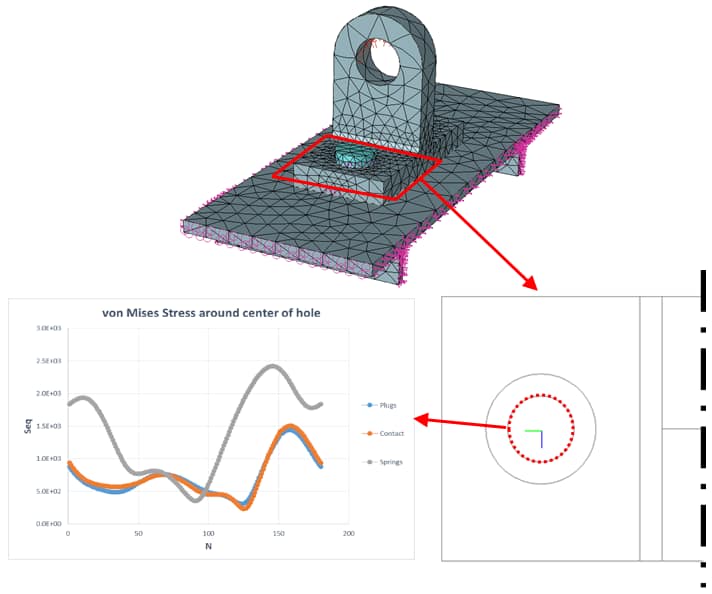
This webinar will focus on best practices for accurately modeling & analyzing fastened connections and joints, including appropriate simplifying assumptions based on the data of interest.
WEBINAR HIGHLIGHTS
- Hierarchic modeling of fastened connections, including Planar-only (fastener + link + 2D elements), multi-body contact (load transfer between all parts), plug/partial contact (load transfer between notable parts), & normal springs (compression-only single part analysis) approaches.
- Pros, cons and applicability of each hierarchic approach will be analyzed.
- CASE STUDY: 3D Lug Comparison – Multi-body contact, plug/partial contact & normal springs.
- LIVE DEMO: You will learn the process of checking reactions in contact regions/holes, as well as how to perform live-dynamic processing of detailed stresses in multi-part assemblies.
WATCH THIS WEBINAR

Interested in a Demo, Evaluation or Purchase?



Have a Software Question, Issue or Feature Request?